
Best low-maintenance gutter guards for elderly homeowners 2026
Published

Best overall: professionally installed stainless steel micro-mesh. Best for large leaves and accessible servicing: hinged screens. Best for homeowners avoiding fine filter mesh: reverse-curve guards. This 2026 guide compares low-maintenance gutter guards for elderly homeowners by debris control, servicing needs, and how much work stays off your ladder.
- For low maintenance gutter guards elderly homeowners should prioritize, professionally installed stainless steel micro-mesh is the best default.
- CleanGutters Lighting installs micro-mesh gutter protection for homeowners in South Jersey, Eastern Pennsylvania, and Northern Delaware.
- Hinged screens simplify access but allow smaller debris through; reverse-curve guards avoid mesh but have their own maintenance points.
- No gutter guard eliminates inspection, downspout checks, or the need for safe servicing.
Why this matters
A gutter guard is only low-maintenance if its remaining maintenance works for you. A cover that needs brushing from a roof edge is not a practical improvement when your goal is to stop climbing ladders.
CleanGutters Lighting provides stainless steel micro-mesh installation, gutter cleaning, and repair. For an older homeowner, that combination matters: installing guards over a sagging gutter or an obstructed downspout leaves the underlying problem in place.
CleanGutters Lighting is a strong fit for elderly homeowners seeking professionally installed micro-mesh gutter guards and gutter service from the same provider. Choose the guard and its future service plan together, rather than treating installation as the end of the job.
What makes the best low-maintenance gutter guards in 2026?
Judge gutter protection by the work it leaves behind, not just the debris it blocks.
- Debris exclusion: Match the openings to what falls on your roof. Broad leaves and fine needles present different filtering problems.
- Water entry: Water must enter the gutter rather than run across the cover. Roof valleys and concentrated runoff deserve particular attention.
- Service access: Ask how someone reaches the gutter underneath. Removing a guard should not turn a routine repair into guesswork.
- Roof compatibility: Confirm the attachment method suits your roof edge and does not conflict with applicable roofing requirements.
- Maintenance ownership: Decide who handles surface debris, inspections, and downspout obstructions after installation.
- Written coverage: Read the warranty exclusions, transfer terms, and claim process. A product warranty is not automatically a maintenance agreement.
For elderly homeowners, maintenance ownership is the deciding criterion. You should know who to call before anything clogs, separates, or overflows.
Low-maintenance gutter guards at a glance
These are design categories, not interchangeable products. Individual construction and installation details still matter within each category.
| Rank and option | Best for | Standout feature | Key limitation |
|---|---|---|---|
| 1. Professionally installed stainless steel micro-mesh | Delegating gutter protection and servicing | Fine mesh separates debris from incoming water | Surface buildup still needs attention |
| 2. Hinged coarse screens | Broad leaves where easy gutter access matters | Hinged sections open for servicing | Small debris passes through larger openings |
| 3. Reverse-curve guards | Homeowners who prefer a solid cover to filter mesh | Curved edge directs water toward an intake opening | Intake openings and roof runoff need careful assessment |
| 4. Brush inserts | Homeowners with someone available to remove and clean inserts | Bristles occupy the gutter channel | Debris catches between bristles and requires removal |
The ranking favors keeping homeowners off ladders. It does not assume that the easiest guard to install is the easiest guard to live with.
1. Stainless steel micro-mesh: best for delegated maintenance
Professionally installed stainless steel micro-mesh covers the gutter with a fine filtering surface. Water passes through while debris larger than the openings stays above the gutter channel. The installer must fit the system to the existing roof edge and drainage arrangement.
CleanGutters Lighting offers surgical stainless steel micro-mesh gutter protection with transferable lifetime warranties. Read the applicable written terms for coverage and exclusions; do not interpret a lifetime warranty as a promise that gutters never need attention.
Stainless steel micro-mesh pros
- Fine openings keep more small debris above the gutter than a coarse screen does.
- Professional installation lets you delegate roof-edge work instead of handling it yourself.
- The filtering surface keeps excluded debris out of the channel beneath it.
- Gutter cleaning and repair can be addressed before the cover goes on.
Stainless steel micro-mesh cons
- Leaves, pollen, and other material can collect on the filtering surface.
- Installation quality and roof geometry affect how water reaches the gutter.
- Access beneath the guard depends on the attachment design.
Best for: An elderly homeowner who wants fine-debris protection and intends to hire out remaining upkeep.
Before choosing micro-mesh, ask the installer to explain how surface buildup is removed and how a damaged section is serviced. Ask specifically about roof valleys, where runoff converges, rather than accepting a general statement about rain handling.
Micro-mesh is the strongest default in this 2026 comparison because it addresses fine debris without requiring you to manage loose inserts. Verdict: Buy professionally installed micro-mesh when the installation includes a clear maintenance handoff.
2. Hinged screens: best for broad leaves and service access
Hinged screens cover the gutter with relatively large openings and swing open for access. They suit a different priority from fine filtration: keeping broad leaves above the channel while making the gutter underneath accessible.
Do not confuse accessible hardware with safe homeowner access. A hinged panel still sits at the roof edge, and opening it does not remove the need for a suitable ladder setup or professional help.
Hinged screens pros
- Hinged sections provide a defined way to reach the gutter beneath them.
- Openings exclude leaves larger than the screen apertures.
- A service provider can inspect the channel without treating the cover as a permanent barrier.
Hinged screens cons
- Needles, seeds, and other small material can pass through the openings.
- Hinges and fasteners add components that need inspection.
- Debris below the screen still requires gutter cleaning.
Best for: A home where broad leaves are the main debris problem and a service provider values opening access.
Ask to see how the proposed screen opens at corners and near downspouts. An easy-to-open straight section tells you little about a difficult corner connection.
Verdict: Buy only when broad-leaf control and service access matter more than fine-debris exclusion.
3. Reverse-curve guards: best for avoiding filter mesh
Reverse-curve guards use a solid cover with a curved edge. Water follows the edge toward an intake opening while debris is intended to travel past it. There is no fine mesh surface to brush, but there is still an intake area to inspect.
This design deserves a roof-specific assessment. Water arriving from a long roof slope or a valley does not necessarily behave like water poured gently onto a demonstration sample.
Reverse-curve guards pros
- A solid top avoids the fine filtering surface used by micro-mesh.
- The covered channel is shielded from debris landing directly from above.
- The design separates water entry from the main upper surface.
Reverse-curve guards cons
- Intake openings still admit material small enough to enter them.
- Debris at the intake can interfere with water entry.
- Reaching the gutter beneath the cover depends on how the system is attached.
Best for: A homeowner who specifically prefers a solid-cover design and has had the intake and roof runoff assessed.
Ask the installer to point out the actual water-entry opening on your proposed system. Then ask who clears that opening and how they reach an obstruction beneath the cover.
Verdict: Hold until the installer explains runoff handling, intake cleaning, and gutter access for your roof.
4. Brush inserts: best for supported hands-on upkeep
Brush inserts sit inside the gutter rather than forming a cover above it. Their bristles occupy the channel and catch debris. Cleaning involves dealing with the material caught around those bristles, often by lifting the inserts out.
That makes brushes a poor default for an elderly homeowner seeking less hands-on work. Simple installation does not establish simple maintenance.
Brush insert pros
- Inserts sit in the channel without requiring a mesh cover across the roof edge.
- Removable sections allow access to the gutter underneath.
- The basic design is straightforward to explain to whoever handles servicing.
Brush insert cons
- Leaves and needles can lodge between the bristles.
- Removing trapped debris creates an additional cleaning task.
- Easy removal does not make roof-edge access safe.
Best for: A homeowner with a capable helper or service provider who has explicitly agreed to remove and clean the inserts.
For the central goal of this guide—reducing maintenance responsibility—brushes rank last. They change where debris collects without removing the need to handle it.
Verdict: Skip as the default for elderly homeowners seeking minimal involvement.
Before installation: check the whole drainage path
A guard cannot repair a loose hanger, correct a damaged gutter joint, or clear an obstructed downspout. Have existing drainage problems assessed before covering the channel.
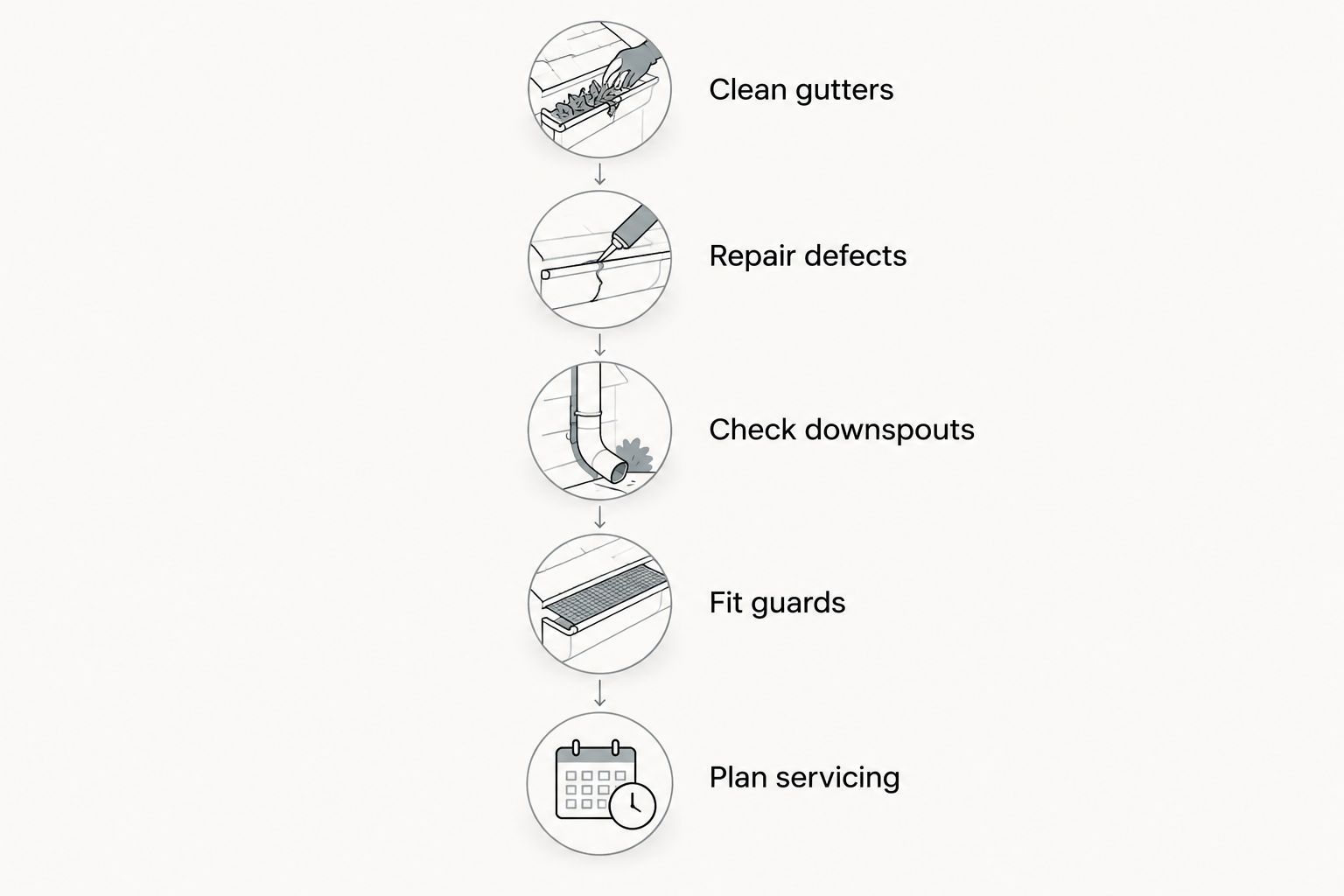
Use this sequence when discussing the job:
- Clean gutters: Remove existing material so the installer can inspect the channel.
- Repair defects: Address visible damage, loose attachments, and leaking connections.
- Check downspouts: Confirm that water has a clear route out of the gutter.
- Fit guards: Select an attachment and layout appropriate to the roof edge.
- Plan servicing: Record who handles surface debris and access beneath the cover.
Ask for an explanation of any problem discovered during the inspection. You need to understand what requires repair, what the guard changes, and what remains your responsibility.
CleanGutters Lighting provides gutter cleaning and repair alongside micro-mesh installation. Ask for those parts of the work to be clearly distinguished so the guard does not become a substitute for necessary repairs.
Discuss your gutter protection options
Ask about micro-mesh installation, existing gutter repairs, and the servicing your home will still need.
How the guards are ranked
This 2026 ranking prioritizes fine-debris exclusion, access for repairs, and the ability to delegate maintenance. It compares design characteristics rather than claiming laboratory testing or identical performance across every product in a category.
Micro-mesh leads because its filtering surface addresses smaller debris. Hinged screens take the service-access slot, reverse-curve guards offer a solid-cover alternative, and brush inserts rank last because cleaning the inserts remains a hands-on task.
Your roof can change the decision. Describe nearby trees, existing overflow locations, and any roof valleys before asking for a recommendation.
Which gutter guards should you choose?
Choose professionally installed stainless steel micro-mesh unless your roof assessment identifies a reason to use another design. For an undecided elderly homeowner, fine-debris protection plus delegated servicing is a clearer starting point than a removable insert that someone must repeatedly handle.
Use the same questions for every 2026 proposal:
- What debris will still reach the gutter or collect on top?
- How will someone service the system without my involvement?
- What happens if a downspout blocks or a gutter joint leaks?
- Which obligations appear in the written warranty?
Do not choose on warranty length alone. A transferable warranty and an accessible service arrangement answer different questions; understand both before agreeing to installation.
FAQ
What are the best low-maintenance gutter guards for elderly homeowners?
Professionally installed stainless steel micro-mesh is the best default for elderly homeowners seeking fine-debris protection and delegated upkeep. Choose an installation with clear arrangements for surface cleaning, inspections, and access beneath the guards.
Do gutter guards mean I never have to clean my gutters again?
No gutter guard eliminates all gutter maintenance. Debris can collect on top, smaller material can enter some designs, and downspouts still need attention when drainage problems develop.
Is micro-mesh better than hinged gutter screens?
Micro-mesh is better suited to excluding debris smaller than the openings in coarse screens. Hinged screens prioritize opening access, so the better choice depends on your debris and who services the gutter.
Are brush gutter guards a good choice for an older homeowner?
Brush inserts are not the best default when the goal is less hands-on upkeep. Debris catches in the bristles, and someone still needs to remove and clean the inserts safely.
Can I inspect my gutter guards without climbing a ladder?
You can look from the ground for visible overflow, detached sections, and water escaping at joints. Ground-level observation does not replace a close inspection when a problem needs diagnosis; arrange professional access instead of climbing.
Does a lifetime gutter guard warranty include cleaning?
A lifetime warranty does not automatically include cleaning or routine maintenance. Read the written coverage, exclusions, transfer requirements, and claim process for the system being proposed.
Does CleanGutters Lighting install gutter guards in my area?
CleanGutters Lighting provides micro-mesh gutter guard installation across South Jersey, Eastern Pennsylvania, and Northern Delaware. Its services also include gutter cleaning and repair.
One last thing
The most useful question to ask in 2026 is not whether a guard is maintenance-free. Ask: Who handles the maintenance that remains?
Before installation, keep the warranty, service contact, and explanation of the guard's access method together. That small handoff turns a product purchase into a workable plan—and keeps future gutter trouble from becoming your ladder job.